
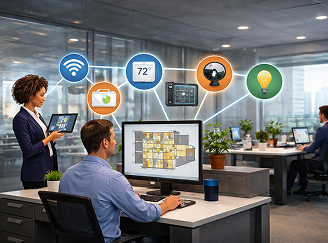
In 2026, where we live and work has blurred, not just in location, but in technology. The same seamless convenience we expect from smart home automation is now becoming a standard requirement for the modern workplace.
Transitioning from manual operations to an automated environment isn’t just about “looking high-tech”—it’s about optimizing human potential. Here is a look at the essential smart office automation tools, their features, and why your workplace needs them today.
1. Intelligent Lighting Control
Just as smart home automation allows you to set the mood for a movie night, smart office lighting adapts to the workday.
Key Features: Occupancy sensors, daylight harvesting (adjusting brightness based on natural light), and automated scheduling.
The Benefit: Energy consumption can be reduced by up to 40%. Beyond the bills, “circadian lighting” mimics natural sunlight patterns, reducing eye strain and keeping your team energized during that 3:00 PM slump.
2. Smart HVAC & Climate Management
Nobody works well in a frozen tundra or a sauna. Smart climate systems use IoT sensors to maintain the “Goldilocks” zone of productivity.
Key Features: Multi-zone control, remote adjustment via mobile apps, and integration with weather forecasts.
The Benefit: By cooling or heating only occupied areas, businesses typically see a 20–35% reduction in energy overhead. It also ends the “thermostat wars” between coworkers.
3. Automated Security & Access Control
Security in 2026 has moved far beyond physical keys. Modern offices now borrow the robust encryption and ease of use found in high-end security systems for smart office automation.
Key Features: NFC/mobile credentials (using your phone as a key), AI-powered surveillance with facial recognition, and real-time entry logs.
The Benefit: You gain total visibility over who is in the building. If a door is left propped open or an unrecognized face enters a restricted zone, the system sends an instant alert to management.
4. Smart Conference Rooms & Collaboration Hubs
The “hybrid” era demands that meetings start on time without a 10-minute struggle with cables.
Key Features: One-touch “Meeting Start” scenes that dim lights, lower shades, and power up the AV system simultaneously.
The Benefit: It creates a professional impression for clients and removes the technical friction that kills creative momentum.
Why the Shift? Comparing the “Smart” Evolution
| Feature | Traditional Office | Smart Office (2026) |
| Energy Usage | Always on / Manual | Sensor-driven / Optimized |
| Security | Physical keys / Badges | Biometric / Mobile ID |
| Maintenance | Reactive (Fix when broken) | Predictive (AI alerts) |
| Employee Experience | Static / One-size-fits-all | Personalized / Adaptive |
The Strategic Advantage: Productivity Meets Sustainability
The true power of these tools lies in hyperautomation. In 2026, we are seeing the rise of “Agentic AI,” autonomous software that can coordinate these tools for you. For example, your office system can see your calendar, realize a meeting is running late, and automatically adjust the climate and lighting in the next room to save power.
By integrating the logic of smart office automation into the corporate world, you aren’t just buying gadgets; you are building an ecosystem.
Key Takeaways for Business Leaders:
Start with Core Needs: Focus on lighting and HVAC first for the fastest ROI.
Prioritize Integration: Ensure your tools “talk” to each other through a centralized hub.
Think Employee-First: Automation should remove “menial” tasks (like hunting for a light switch), allowing your team to focus on high-value work.
Is your workplace ready for the upgrade? The transition to a smart office is no longer a luxury, it’s the foundation of a competitive, efficient, and modern business.