
I’ve been in the AV and home integration industry for over a decade, and one question comes up on almost every single project:
“Can we have music playing in different rooms?”
The answer is always yes. But how you get there makes all the difference, and most homeowners, and even some builders, don’t realize there are fundamentally two different approaches to achieving it.
Let me break it down.
What Is Distributed Audio?
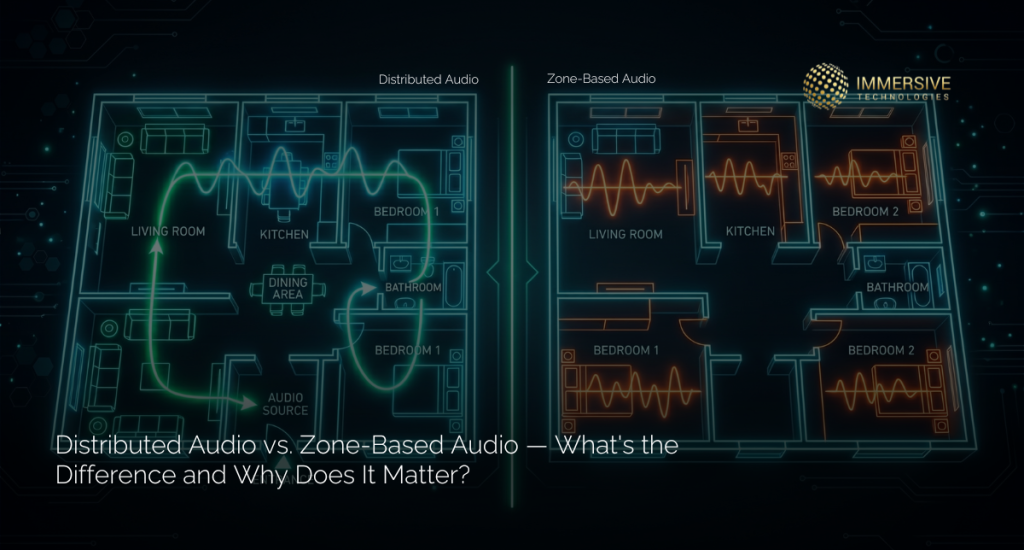
Distributed audio is exactly what it sounds like, a single audio source (or multiple sources) distributed across your entire home through a centralized system. Think of it like a hub-and-spoke model. One central amplifier or matrix system pushes audio out to speakers installed in every room, hallway, patio, or garage you want covered.
The key characteristic? Everything is managed from one place.
You control volume, source selection, and zones from a single app, touchscreen, or control panel. High-end systems from brands like Sonos, Crestron, Savant, or Autonomic make this seamless, allowing you to play the same song throughout the entire home or different content in different areas, all from one interface.
Best for: Larger homes, luxury builds, hospitality environments, and anyone who wants a truly polished, whole-home audio experience.
What Is Zone-Based Audio?
Zone-based audio is a subset of distributed audio, but the distinction matters. In a zone-based system, your home is divided into specific “zones,” and each zone can be independently controlled. The living room is one zone. The master bedroom is another. The backyard is a third.
Each zone can have:
- Its own volume level
- Its own audio source
- Its own on/off control
So while your kids play music in the basement, you’re listening to a podcast on the patio, and the kitchen is completely silent, all simultaneously, all independently.
Best for: Families with different listening habits, open-plan homes where sound bleeds between spaces, and projects where flexibility is the top priority.
So What’s the Actual Difference?
Here’s where I see the most confusion on job sites and in client meetings:
Distributed audio refers to the infrastructure, the wiring, amplification, and signal routing that make whole-home audio possible.
“Zone-based audio” refers to the control logic, how that infrastructure is divided, and independently managed.
In practice, most modern whole-home audio systems are both. But the way a system is designed and installed determines how flexible and reliable the zones will actually be. A poorly planned distributed system will give you zones that bleed sound into each other, volume imbalances between rooms, and a control experience that frustrates more than it impresses.
This is why pre-wire planning, done before a single wall is closed, is absolutely critical. Once the drywall goes up, your options shrink dramatically.
The 3 Questions I Ask Every Client Before Designing an Audio System
1. How many people will be using this system daily, and do they have different tastes? If yes, zone independence becomes a priority over simplicity.
2. Do you entertain frequently? If yes, whole-home synchronization, the ability to play one source everywhere, becomes essential. Party mode is a real feature, and clients love it.
3. What’s your long-term vision for this home? A system designed only for today will frustrate you tomorrow. I always design for a family’s life 5–10 years out, not just their needs at move-in.
The Bottom Line
Distributed audio gives your home a voice. Zone-based control gives every person in it their own.
The best systems do both, seamlessly, reliably, and in a way that your family actually uses every single day. Because the most expensive audio system in the world is worthless if it’s too complicated to turn on.
If you’re a builder, architect, or homeowner planning a new build or renovation, have the audio conversation before the framing conversation. The infrastructure decisions made early in construction determine everything about what’s possible later.
Have you ever moved into a home where the audio system was an afterthought? Or worked on a project where the pre-wire planning made all the difference? Drop your experience in the comments, I’d love to hear it.

https://shorturl.fm/eUFlm