
Does lighting automation actually save money, or is it just a gimmick? (India, did the math.)
Electricity bills come up in every group chat lately, especially among those in the NCR. Usual suggestions: switch to LEDs, get a 5-star AC, maybe solar if you own the place. Nobody ever mentions lighting automation, and I get why most people think “smart lighting” just means changing your bulb to purple for a party from an app. That’s not really what I’m talking about.
I work in this space (home automation/AV, India market), so I figured I’d actually lay out the numbers instead of just saying “yeah, it helps.”
The waste isn’t the bulbs, it’s the habits
Lighting was never the biggest part of anyone’s bill, AC and water heating crush it. But it’s the most wasted part because it’s almost always forgotten, not the equipment. Passage light is on all day. Guest room, nobody checks. Outdoor lights on a flat 6 pm-6 am timer in June when it’s still bright at 7 pm.
A motion sensor in a passage just kills that problem outright. A light sensor near a window dims/cuts the fixture when there’s enough daylight relevant for most of the year here, not just two months. Outdoor lighting tied to an actual sunset/sunrise clock instead of a dumb timer stops burning power on long summer evenings.
Dimming is the most underrated part, honestly. Most homes run lights at full brightness 24/7 regardless of need, and LED draw scales pretty closely with brightness, so even modest dimming during low-activity hours adds up.
Actual numbers, not rounded-up-to-sound-good numbers
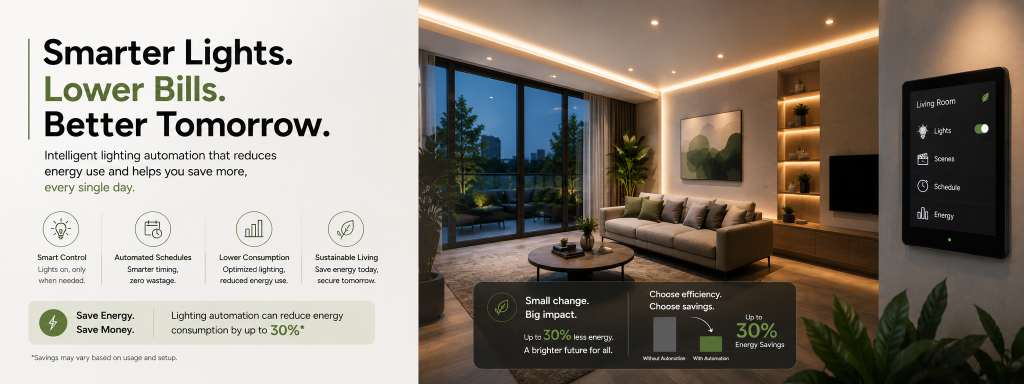
3BHK, ~1800 sq ft, standard LEDs: lighting is usually 8-12% of the monthly bill. Add occupancy sensing, daylight response, and real scheduling in common areas/passages/outdoors, and you’re cutting that lighting slice by 25-35%. Not the whole bill, just that slice.
On a ₹6-8k bill, that’s roughly ₹150-300/month. Not huge on its own, I won’t pretend otherwise. But a decent DALI or KNX setup lasts 10+ years easily, so over that time it actually offsets a real chunk of what you paid upfront.
Villas see bigger numbers because outdoor/landscape lighting is the worst offender for fixed-timer waste, boundary walls, driveways, and RWA common areas.
Cost-wise
- Few rooms (passages, bathrooms, store room), basic occupancy + scheduling, retrofit, no rewiring: ₹15-25k
- Full setup daylight harvesting, DALI dimming on living/dining, astronomical clock for outdoor for a 3BHK: ₹80k-1.5L depending on circuits
- Villas with landscape lighting + BMS integration: ₹3-5L, but at that point, the same sensors are also triggering AC scheduling, so the case gets stronger
Smart switches vs DALI
Basic Wi-Fi switches = fine for on/off and schedules, but no real dimming precision. DALI is built for proper commercial-grade dimming, is individually addressable, way better daylight response. Single room → smart switches are fine. Whole home/villa → DALI pays back faster because there’s more load to actually optimize.
The part that’s not a fun sell
If your AC and geyser are unmanaged, lighting automation alone won’t move your bill much. Those two dwarf lights. This is one piece of a bigger strategy, not a magic fix. Where it actually shines is in common areas, outdoor zones, passages, and predictable waste that’s easy to kill.
TLDR: Not going to replace solar or AC optimization as your main move, but it’s low-disruption, retrofit-friendly, and pays back in under 5 years in most setups. The biggest mistake is people treating it as a luxury thing instead of what it actually is, on paper, a small but real saving.
Curious what others are actually running (DALI/Zigbee/basic switches) and what dent it’s made on your bill. Real numbers > spec sheets.