
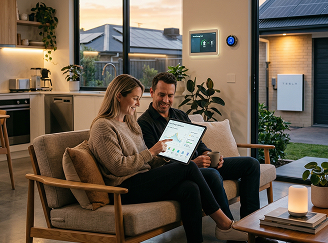
In 2026, the concept of a “smart home” has evolved far beyond voice-controlled light bulbs and video doorbells. As energy costs fluctuate and the push for sustainability hits its stride, homeowners are looking for more sophisticated ways to manage their resources.
Enter the Building Management System (BMS) approach—a technology once reserved for massive skyscrapers and industrial plants that is now being scaled down to revolutionize residential living. Here is why integrating a home energy management system is no longer a luxury but a necessity for the modern homeowner.
1. Unprecedented Cost Savings
The most immediate benefit is the impact on your wallet. A residential-scale Building Management System allows you to move away from “passive” consumption. Instead of receiving a surprise bill at the end of the month, you can monitor usage in real-time.
Peak Shaving: Automatically shift energy-heavy tasks—like running the dishwasher or charging your EV—to off-peak hours when rates are lowest.
Phantom Load Elimination: Identify “vampire” appliances that draw power even when turned off, potentially saving you up to 10% on your annual energy costs.
2. Seamless Integration with Renewables
Modern homes are increasingly becoming mini-power plants. Whether you have solar panels, a wind turbine, or a battery backup like a Tesla Powerwall, a building management system acts as the “brain” of the operation. It decides when to use generated power, when to store it, and when to sell it back to the grid for a profit.
3. Enhanced Comfort and Health
A sophisticated energy management setup does more than just dim the lights. By adopting the principles of a building management system, your home can synchronize HVAC (heating, ventilation, and air conditioning) with occupancy sensors and weather forecasts.
Predictive Cooling: If the system detects a heatwave is coming, it can pre-cool your home during cheaper morning hours.
Air Quality Monitoring: Modern systems can trigger ventilation based on $CO_2$ levels or humidity, ensuring the air you breathe is always fresh.
4. Increased Property Value
Sustainability is a major selling point in today’s real estate market. Homes equipped with an integrated building management system often command higher resale values. Buyers are increasingly looking for “future-proof” homes that offer lower operational costs and a smaller carbon footprint.
5. Predictive Maintenance and Safety
One of the most overlooked benefits of a building management system is its ability to act as an early warning system. By monitoring the electrical “signature” of your appliances, the system can detect when a refrigerator motor is about to fail or if there is an unusual surge in a circuit. This prevents expensive emergency repairs and significantly reduces the risk of electrical fires.
Comparison: Traditional Home vs. BMS-Enabled Home
| Feature | Traditional Home | Modern BMS Home |
| Energy Visibility | Monthly Paper Bill | Real-time Digital Dashboard |
| HVAC Control | Manual Thermostat | AI-Driven Predictive Comfort |
| Renewable Usage | Manual/Standard Inverter | Automated Grid/Storage Optimization |
| Maintenance | Reactive (Fix when broken) | Proactive (Alerts before failure) |
Conclusion: The Era of Intelligent Living
Transitioning to a home energy management system is about more than just saving a few dollars; it’s about taking control of your environment. By leveraging the power of a building management system, you turn your home into a responsive, efficient, and sustainable sanctuary.
As we move further into 2026, the question isn’t whether you can afford to install these systems—it’s whether you can afford not to.